
 AI and strategy
Future of marketing: traditional vs. generative AI (2026)
The future of marketing: traditional and generative AI marketing compared on cost, speed, testing and measurement, plus the new EU rules for AI labels.


Written by Genly's AI team, reviewed by Marlon Bonink
· 9 min read

For most small businesses, marketing has followed the same recipe for years: hire an agency or a freelancer, book a shoot, run a handful of ads and hope one of them works. That recipe is changing fast, because Meta, Google and TikTok are building generative AI straight into their own ad tools. Below, we put traditional and AI-driven marketing side by side: what changes, what stays human and which rules apply.
Short answer: The future of marketing is one where generative AI handles most of the making, testing and optimising of ads, so even a small business on a tight budget can make and test far more variations than it used to. What AI does not replace: your strategy, your brand, your customer relationships and the judgement about what is right. And since 2 August 2026, realistic AI visuals that could pass as real must be clearly labelled in the EU.
What is changing: the ad platforms are building AI in
The biggest shift is coming from the ad platforms themselves.
- Meta said on its earnings call of 29 July 2026 that more than 9 million small businesses now use at least one of its AI ad creative tools, and that its automated Advantage+ campaigns have passed a 75 billion dollar annual revenue run-rate (Meta Q2 2026 transcript). Mark Zuckerberg described the end goal in May 2025: a business tells Meta its objective, connects a bank account and no longer needs its own creative, targeting or measurement (Stratechery interview, 2025).
- Google showed at Google Marketing Live (20 May 2026) that Asset Studio generates ads from your brief, brand guidelines and website, with one-click A/B testing (Google, 2026). It also announced Ask Advisor, an AI agent that works across Google Ads, Analytics and Merchant Center, in beta for English-language accounts (Google, 2026).
- TikTok launched Symphony Agent in June 2026, which spots trends, generates videos and matches brands with creators (TikTok, 2026).
In the Netherlands, one in six companies used AI in 2025, double the 2023 share, and marketing or sales was the top use case: 35 percent of those companies applied AI there (Statistics Netherlands, December 2025).
Traditional vs. generative AI marketing: the comparison
Here is how the two approaches compare for an online store, a clinic or a home services company.
| Traditional marketing | Marketing with generative AI | |
|---|---|---|
| Cost | You pay per production: a shoot, a designer, a creator or agency hours. Every new version costs again. | You pay a subscription or credits. An extra variation costs little, so budget shifts from production to media spend. |
| Speed | Days to weeks from brief to live. | Minutes to hours from idea to ad. |
| Testing | Two or three variations per campaign, because each one needs production. | Many variations of hook, visual and copy. The numbers pick the winner. |
| Creation | Manual work by a photographer, videographer and copywriter. | AI produces images, video, voice-over and copy based on your brand. A human approves. |
| People or agency | An agency or freelancers for design, video and campaigns. You pay for hours and meetings. | AI does the execution. You or a small team direct and decide. |
| Measurement | A report after the fact, adjustments once a month. | Daily numbers and suggested changes that you approve. Note: a platform also grades its own homework. |
| What stays human | Nearly everything. | Strategy, brand, customer relationships and the final call. |
In short: when making ads is expensive, you bet everything on a few of them. When making ads is cheap, the skill shifts from producing to choosing: what to test, what to stop and what fits your brand.
Why testing now beats the perfect ad
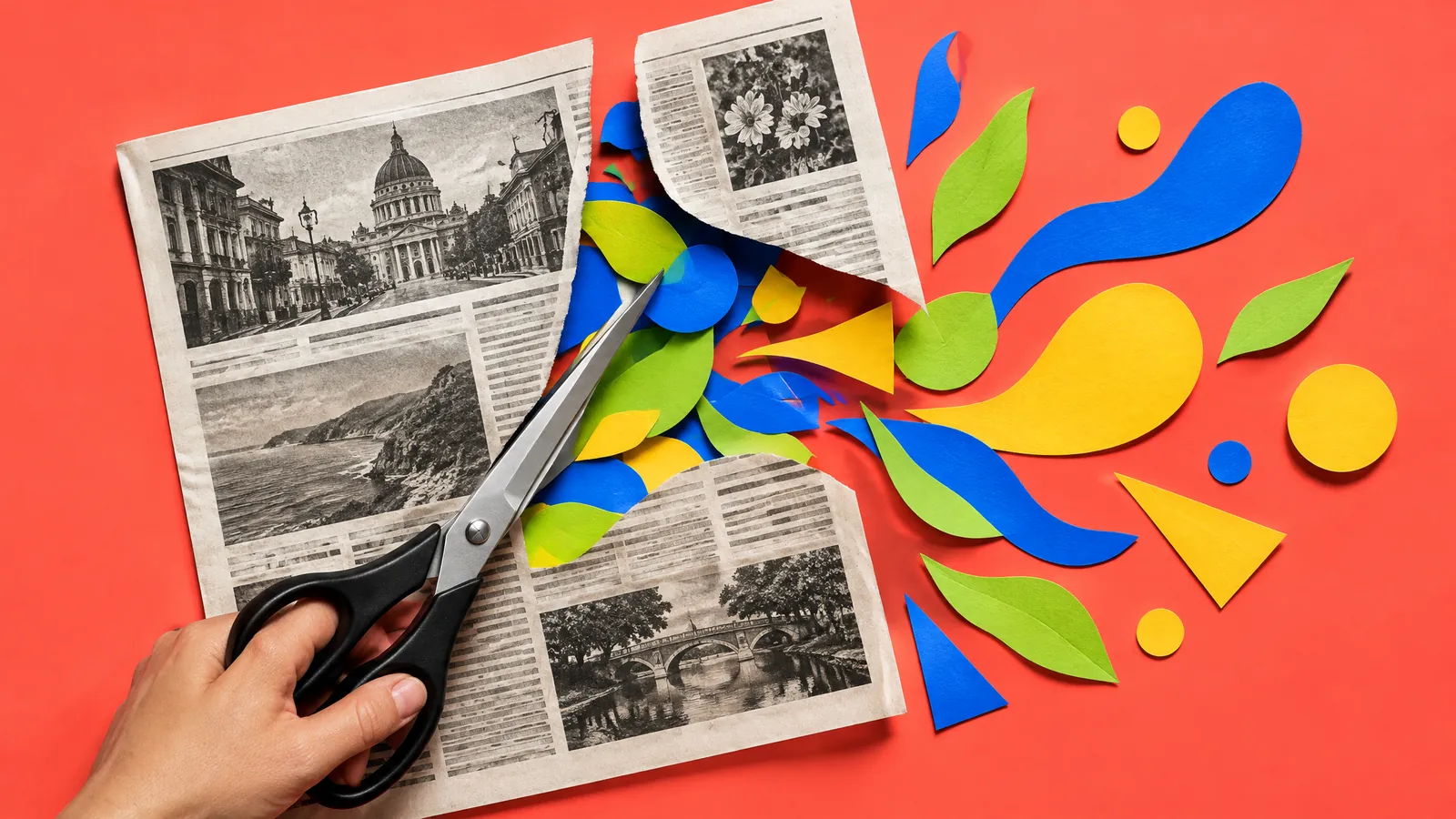
The platforms are now built for volume. In late 2024 Meta rebuilt the system that decides which ad each person sees, because automation and AI were generating far more ads. By then, over a million advertisers were creating more than 15 million ads a month with Meta's generative AI tools (Engineering at Meta, 2024). Google is building testing directly into Asset Studio.
So stop polishing one perfect video per quarter. Develop a few genuinely different ideas and give each one several openings, because the first seconds decide whether someone keeps watching. On a small budget, test five different angles rather than fifty tiny tweaks of one idea. Otherwise no single variation gets enough impressions to prove anything.
For a step-by-step walkthrough, read how to make AI video ads.
From separate tools to an AI marketing team
The next step is AI that does not just answer questions but carries out tasks: an AI agent. It creates ads, sets up campaigns and reads the results. Google's Ask Advisor is one example, and Meta says more than 1 million businesses a week already use its business agents to talk to customers or close sales (Meta, Q2 2026).
Salesforce's State of Marketing report found a catch: 75 percent of marketers have adopted AI, yet still use it to send one-way, generic campaigns. Salesforce's Bobby Jania put it bluntly: "We are using the most powerful technology in history to send more one-way spam, faster" (Salesforce, February 2026). AI without context about your customer and your brand mostly gives you more, not better.
Genly is one example. In a single conversation, Genly acts as your account manager and directs a team of AI specialists: a Graphic Designer for static ads, a Videographer for video ads and AI UGC, an Ads Researcher who studies what works for your competitors, a Media Buyer for Facebook and Instagram campaigns, and a Social Media Manager for organic posts. Genly learns your brand from a scan of your website. The Media Buyer sets campaigns up paused, and nothing goes live until you click. See the AI marketing team or read what is Genly. Prefer to connect an AI assistant yourself? Read Claude for marketing.
What AI does not solve
Generative AI is a huge accelerator, but four things stay with you:
- Strategy. AI does not decide who your customer is, what you offer or why people should buy from you. Without those choices, you get average ads.
- Your brand. Every marketer has access to the same AI models, as Salesforce notes. Your story, tone and offer set you apart.
- Real customer relationships. Reviews, service and genuine customer stories cannot be generated. An AI presenter can explain your product, but it is not a happy customer.
- Human judgement. AI can exaggerate a claim, get a product detail wrong or miss the tone. Someone has to approve before anything goes live.
Trust matters too. An IAB survey of US consumers found that 82 percent of ad executives believe Gen Z and millennials feel positive about AI-generated ads, while only 45 percent of those consumers say they do (IAB, January 2026).
The rules: labelling AI content under the EU AI Act
Article 50 of the EU AI Act has applied since 2 August 2026. For advertisers: if you show realistic AI people, places or events that could pass as real, you must disclose that clearly, at the latest when someone first sees the ad. The label has to be visible or audible; an invisible technical watermark alone is not enough. Fines can reach 15 million euros or 3 percent of worldwide turnover, with proportionality for smaller companies (European Commission, 2026).
A label does not fix a misleading ad, though. The Dutch advertising code, for example, says AI and virtual influencers must not be used in a misleading way (Stichting Reclame Code, 2026). In practice:
- Put the label up front, on screen or spoken, such as "made with AI". Do not bury it in the caption.
- Never let an AI persona tell a made-up customer story as if it were real. No invented reviews, savings or star ratings.
- Meta adds an "AI info" label to ads significantly edited with its own AI tools (Meta, 2025). Do not rely on that alone: the obligation is yours.
The good news from the same IAB study: 73 percent of Gen Z and millennial consumers said knowing an ad was made with AI would increase or not change their likelihood to buy. In the Genly editor you can add an AI label to your video in one click; our AI transparency page explains how we handle the rules. This is general information, not legal advice.
How to take the first step
- Write your strategy on one page: who your customer is, what problem you solve and why people buy from you.
- Pin down your brand: tone, colours and what you never say.
- Pick one goal and one channel, for example leads from Instagram and Facebook.
- Create three to five genuinely different ideas, each with a few openings.
- Measure what counts: cost per lead or purchase, not likes.
- Keep a human in charge: you approve, you launch, you label.
Frequently asked questions
What is the future of marketing?
Generative AI is taking over more of the execution: creating ads, testing variations and optimising campaigns, built right into the tools of Meta, Google and TikTok. Your role shifts to strategy, brand and making the right choices.
Will AI replace marketers?
It will take over much of the hands-on work: design, variations and reading reports. It will not take over the thinking: who your customer is, what you promise and what fits your brand.
Do I still need a marketing agency?
For making and testing ads, less often than before. A good agency is still valuable for strategy, positioning and big campaigns. A mix often works best: AI for the daily work, an expert for direction.
Do I have to label AI-generated ads?
Yes, in the EU, if you show realistic AI people, places or events that could pass as real. Since 2 August 2026 you must disclose that from the first moment someone sees the ad. Clearly illustrated or animated visuals generally do not need a label.
How much does AI marketing cost?
Many AI marketing tools charge a subscription plus credits per image or video. Genly plans start at 39 euros a month (see pricing). Ad spend on Meta or TikTok comes on top.
Editor
Marlon Bonink
Co-founder of Genly
This article was written by Genly's AI team and reviewed by Marlon before it went live. How we work with AI: AI transparency.





 Video and UGC